
Understanding the 2025 Moldovan Energy Crisis: the Need for Diversification in an Unstable Global Energy Order
By Owen Grossman
Background
On January 1, 2025, Ukraine ended its transit deal with Russia’s state-owned Gazprom. Up to 42 million cubic metres per day of Russian and Kazakhstani gas flowed through Ukrainian territory in the Brotherhood and Soyuz pipelines. President Volodymyr Zelenskyy’s decision to not renew the five-year deal signed in 2019 was made to limit Russian profits fueling the invasion of Ukraine that began in 2022. While this helped much of the European Union to continue its divestment from Russian energy, a crisis began to unfold on Ukraine’s southwestern border.
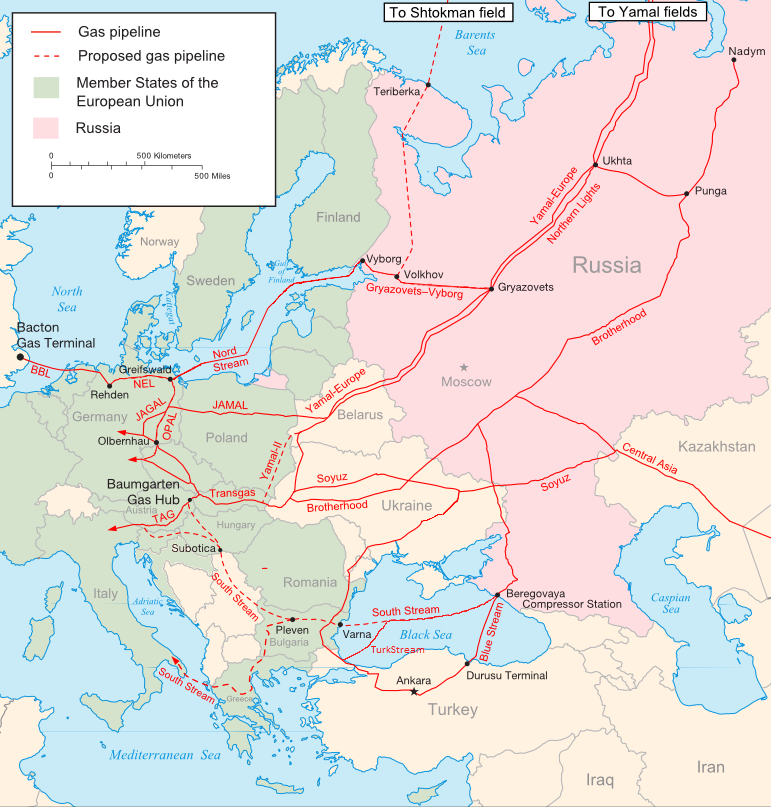
Map of Russian Gas Pipelines
Source: Wikimedia Commons
Moldova, situated in between the Dniester and Prut rivers, gained independence from the collapsing Soviet Union in 1991. In March 1992, a civil war broke out between Moldova and the multi-ethnic and multi-lingual region of Transnistria on the left bank of the Dniester River. They sought to avoid marginalization of the regional Russian and Ukrainian minorities by the nationalist government in Chișinău. The war ended in a stalemate and a ceasefire was declared in July 1992. The Russian 14th Army, which supported Transnistria’s independence, remained as a peacekeeper force. Since then, Transnistria, officially the Pridnestrovian Moldavian Republic (PMR), has been de facto independent, though not recognized by any other United Nations-member state. The government in Tiraspol has since become a regional arm of Russian influence, with Transnistrian President Vadim Krasnoselsky being known to advocate for integration with Russia following a 2006 referendum. This is notable considering the alleged €200 million Russia spent to buy votes in the 2024 Moldovan presidential election and EU referendum. The legacy of this frozen conflict set the stage for the recent energy crisis in Transnistria.
Starting operations in 1964, the Cuciurgan Power Station, under 100% ownership by the Russian company Inter RAO UES, produced electricity with Russian gas in the territory of Transnistria. Without energy production capacity within its area of de facto control, Moldova has historically relied on up to 80% of its electricity needs from Transnistrian imports, thus a dependency on Russia. Moldova faced geopolitical pressure to diversify its energy early. Transnistria, however, has received free gas since 2005, even as it has accumulated $11.1 billion in unenforced debt to Gazprom. The effect of receiving free gas has failed to create a prompt for supply diversification in consideration of high market prices. The energy policy choices of these two states greatly shaped the effectiveness of their response to the 2025 energy crisis.
Different Outcomes
By the time Ukraine ended its deal with Gazprom, Moldova had joined the European Energy Community in 2010, synched with Europe’s Continental Energy Grid and abandoned Russian imported gas in 2022, and started high-level energy policy reform dialogues with the European Union. Moldova’s political readiness to diversify from a single-source energy system prepared it to effectively meet the oncoming crisis.
Moldova has developed a dual path for its energy future in building renewable energy production and integration with the wider EU energy system. As of July 2025, the country had tripled its capacity for renewable energy, effectively creating domestic energy answering the issue of the country’s lack of hydrocarbon resources. Further, progress is underway on three high voltage cables, set to directly connect Moldova’s energy grid with EU member Romania by 2031. This infrastructure will further secure Moldova’s energy security as EU energy set for Moldova currently must be received by the aforementioned Cuciurgan Power Station.
Moldova’s investments in renewable energy are rooted in the country’s lack of domestic hydrocarbon resources, however, it has provided great stability in the long run. As gas prices continue to be unstable due to the Ukraine and now Iran wars, communities like Volintiri are using solar energy and biomass heating systems to keep the most essential institutions running like schools, the town hall, and the customs office. On a wider scale, renewable energy accounts for 40.7% of Moldova’s heating and cooling, as this percentage increases, it permits Moldovan citizens to fend off would-be difficulties when gas supply is unstable. Furthermore, Chișinău is able to handle pressure from the Ukraine war by increasing alternative energy source access. This is especially pertinent as Russia has attacked Ukrainian energy infrastructure which supports Moldova. Steps Moldova’s communities and leadership are taking are effectively establishing energy security through diversification and clean energy development makes the country resilient in the face of an increasingly unstable world energy system.
Transnistria was not prepared for the end of Russian gas supply. The de facto government had saved only enough gas reserves to fuel its northern regions for 10 days and its southern regions for 20 days, Transnistria’s authorities did not have the foresight to prepare for a longer crisis. The Cuciurgan Power Station quickly scaled down operations and switched to coal as rolling blackouts were enforced up to eight-hours per day. All of Transnistria’s industrial firms, barring those necessary for food security, were suspended and school holiday breaks were extended. Despite Gazprom's contractual obligation to supply 5.7 million cubic metres of gas until October 2026 to Moldovagaz, the former official gas supplier of Moldova and owner of Transnistria’s gas supplier Tiraspoltransgaz, Gazprom refused to utilize alternate Russian-owned paths like the TurkStream pipeline. Instead they passed the burden of accused, and disputed, unpaid debts by Moldovagaz (in which Gazprom has majority ownership) onto the people of Transnistria, thus instigating the crisis.
Moldova, better prepared for the crisis, offered to sell gas to Transnistria, an offer to which President Krasnoselsky initially denied receiving and refused any help. He warmed up to the idea of Moldova’s aid later in January, yet faced political and business issues, delaying crucial heat and support for his people in the midst of winter. Having received free gas from Russia before, the government was unwilling to pay for much pricier European gas via Moldova, thus extending the crisis. By the time the European Union offered a €30 million emergency assistance package to navigate the crisis on January 26, 2025. By this time, the President’s tone had changed, claiming that it is “simply absurd and stupid to refuse [help],” a sign that the state’s unpreparedness had become clear since his earlier refusal. It was February 10 once President Krasnoselsky’s office had announced a return to regular and acceptable gas supplies and operations. Over the five weeks that the crisis unfolded, dozens of people were injured from carbon monoxide poisoning and fires related to the lack of gas, five people died. Transnistria entered into a new deal with the Swiss MET Group, which is unsustainably funded by Moscow through an intermediary company in the United Arab Emirates, but this doesn’t mean Tiraspol has secured its energy capabilities. Russia has swapped intermediaries three times and payment issues created a short supply deficit in October of 2025. Although shorter in duration, Transnistria faced further energy issues from March 3-10, 2026 as a result of the crisis in the Persian Gulf. Once again hundreds of residences and educational institutions lost heat and industry was forced to shutter. These failures have also put Tiraspol in an uneasy economic and geopolitical position. A statistical comparison between January 2024 and January 2025 revealed a 60% drop in exports as well as higher unemployment. Presumably, the following crises would have created similar effects. Transnistria’s failure to prepare for the energy crisis not only harmed its people, but also its ability to maintain its economic wellbeing. The clear weakness has made room for Moldova to push for reintegration, as exemplified by a tax and customs law passed following this most recent crisis which would standardize tax policy for Transnistria’s businesses, including its energy sector, to align Moldova’s own. Any state wishing to maintain independence must be willing to be prepared for disaster, something Transnistria failed to do.
Conclusion
Transnistria has failed to adequately invest in alternative renewable energy sources and future energy security. Transnistria may face limitations from its limited international recognition, such as barriers to trade and cooperation with internationally recognized states, which limit its ability to diversify. However, Russia has demonstrated its ability to fund the sourcing of gas from the MET Group for Transnistria, it is conceivable that Russia could directly assist in the diversification process through its funding. Similarly, the EU, which is the recipient of nearly 80% of Transnistria’s exports, and Moldova were prepared to work with Transnistria to resolve the 2025 energy crisis through sales and grants; it is possible they could also negotiate energy reform assistance. Vague prompts from the President have advocated using timber as firewood, an unsustainable source, without proper commitment to diversify and build domestic energy production like Moldova has. Coal is still the state’s major backup source of energy, which is inefficient and unclean. Transnistria’s failure to prepare for the crisis through diversification of energy has harmed its people and industries. It became too reliant on free Russian gas, not understanding that this dependence can create the type of breakdown seen following the end of Ukrainian gas transit. Moldova’s example clearly shows that proper long-term investment in domestically produced energy and in alternate diverse energy sources as a rule, not an exception, is necessary to secure a country from humanitarian and economic crisis as the global energy order becomes increasingly unstable.