
The Åland Question in the age of NATO and Russian threats
By James Orr
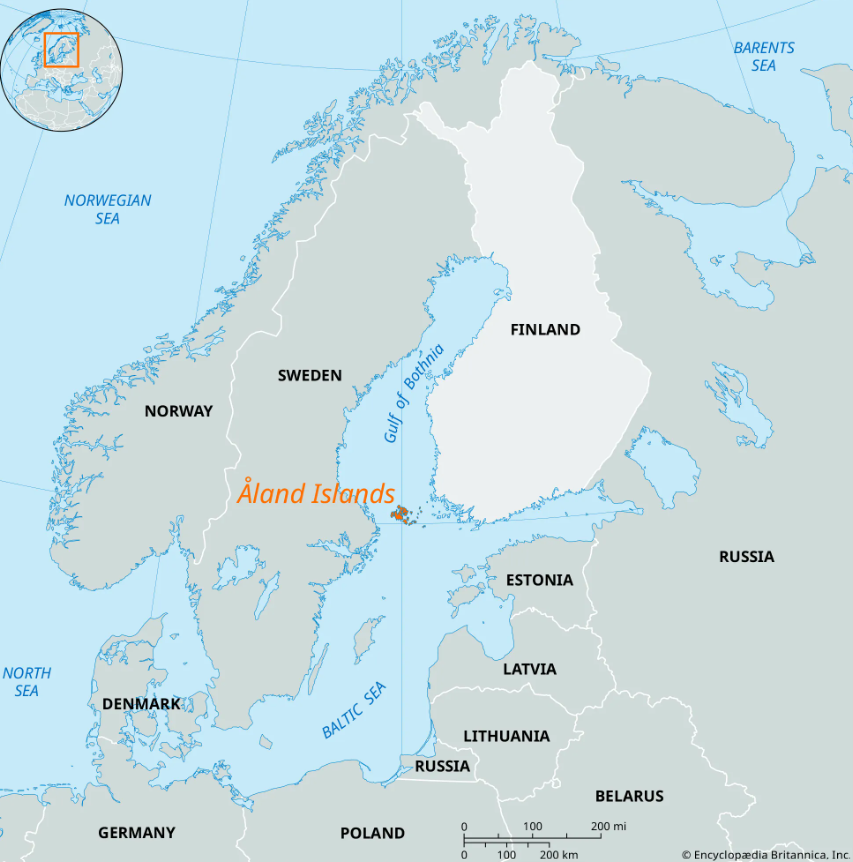
Napoleon Bonaparte once described the Åland Islands as the ‘foreposts of Stockholm’ encapsulating the strategic value of these islands that have been coveted by empires for centuries. Nowadays, the Åland Islands are a Finnish archipelago situated in the Baltic Sea at the entrance of the Gulf of Bothnia. In between Finland and Sweden, this Swedish-speaking archipelago is an autonomous and demilitarized territory in southwestern Finland. The recent enlargement of NATO, with Finland and Sweden joining NATO in 2023 and 2024, in the wake of Russia’s invasion of Ukraine, reflects a broader transformation of the Baltic area in which now the Baltic Sea has been described as a ‘NATO lake’. Despite the disputed nature of that claim, it reflects the broader post-2022 Baltic situation in which Åland finds itself. In light of this new Baltic geopolitical context, one may ask whether the dormant sovereignty and cultural dispute between Finland and Sweden over these islands will revive if Helsinki were to alter Åland’s special regime in response to Russian threats.
For centuries, the Åland Islands were part of the Swedish Kingdom, accounting for the islands’ cultural and linguistic proximity with Sweden. Indeed, Åland is a monolingual Swedish-speaking area. In 1809, following the Russian Empire’s victory over Sweden, the archipelago became part of Russia’s Grand Duchy of Finland. Previously, the islands had been occupied by Russia from 1714 to 1721, which ‘quickly turned the islands into a naval base to attack the coast of Sweden’. This illustrates the historic strategic importance of the islands. As Kamal Makili-Aliyev writes in Contested Territories and International Law (2020), the history of the islands is ‘rich with clashes of European powers trying to use the strategic value of the islands for their own interests’.
Following the Anglo-French destruction of the Russian fortress at Bomarsund in the Åland Islands in 1854, Britain and France used their leverage as victors in the Crimean War to impose conditions on Russia. The 1856 Treaty of Paris, which ended the Crimean War (1853-1856) between the Russian Empire and the Ottoman Empire, had the Second French Empire and the United Kingdom hand the Åland Islands back to the Russians, provided they would become demilitarized. In doing so, France and Britain were able to hinder Russia’s influence in the Baltic Sea, reflecting the strategic importance of Åland and enduring importance of its demilitarization, in force for nearly two centuries. This highlights the extent to which demilitarization is deeply embedded in Åland’s identity. It is important to note that Russia violated this Convention of Demilitarization of 1856 in 1906 by opening a station on Åland to allegedly prevent arms smuggling to Russia. In 1907, Russia even attempted to nullify the 1856 Convention, but failed due to British and Swedish opposition.
In the aftermath of Finland’s independence from Russia in 1917, the question of who possesses the islands returned to the surface. Tensions between Sweden and Finland over Åland rose. Ålanders felt culturally threatened by Finland and wanted to join Sweden. In the context of the 1918 Finnish Civil War, Finnish White Guards were sent to the island, which prompted the Åland delegation to urge Sweden to intervene. In 1919, 95% of Ålanders voted in favor of a reunification with Sweden, escalating tensions between Finland and Sweden over the islands. The Åland question became an ‘ideological and strategic struggle between Sweden and Finland’.
The dispute was taken to the League of Nations in 1921, which ruled that Finland could keep the islands provided it granted a degree of cultural, linguistic and political autonomy. Moreover, this international ruling emphasized Finland had to maintain the demilitarized status and added that the islands were to remain neutral.
Åland’s autonomy is widely considered as one of the most far-reaching and institutionalised forms of territorial self-government in Europe. As Loughlin and Daftary point out in the book Insular Regions and European Integration: Corsica and the Åland Islands Compared (1999), the Åland Islands not only possess their own parliament, called the Lagting, but also their own flag since 1954 and their own postage stamps since 1984. These institutional and symbolic attributes of self-rule strengthen Åland’s unique autonomous status. This special autonomous status is also reflected in Åland’s unique form of regional citizenship. Åland citizenship, formally known as the right of domicile, is required to vote or run in elections in Åland and to own land. This regional nationality can only be granted at birth or if a Finnish citizen lives for more than five years in Åland and is proficient in Swedish. As Hannikainen and Horn underline in the book Autonomy and demilitarisation in international law: the Åland Islands in a changing Europe (1997), the 1979 Oinas Case reinforced the linguistic dimension of Åland’s autonomy by confirming that sufficient knowledge of Swedish was necessary in order to obtain the right of domicile. This highlights the tight interconnection between language, identity and legal autonomy in Åland.
Furthermore, given that the islands are to remain neutral, if Finland were to go to war, Åland would not be involved. Ålanders are also exempt from Finland’s military conscription. Moreover, the Lagting needs to agree to international treaties signed by Finland for it to apply to ‘areas falling within Åland’s competence’ and the islands enjoy specific derogations from the EU with regards to duty-free trade, solidifying Åland’s special autonomous regime. Therefore, in light of this unique autonomy, any attempt by Finland to alter it under the pretext of Russian aggression in the Baltic Sea would face significant legal and political constraints.
The demilitarized and neutral stance of the Åland Islands has been at the core of its geopolitical identity. In a sense, one could argue that it enabled the islands to develop their own idiosyncratic autonomy, resilient to century-old imperial threats. For a long time, the islands were regarded as a successful model of conflict resolution. Hannikainen wrote in 1997 that the issue of remilitarization or de-neutralisation is no longer what is at stake for Åland, reflecting how the 1990s’ zeitgeist regarded the islands as a paragon of conflict resolution. Nonetheless, the current settlement’s resilience is being increasingly tested by the evolving geopolitical context in the Baltic Sea. The growing perceived Russian threat in the Baltic Sea is raising questions about the current demilitarized and neutral nature of the Åland Islands.
In recent years, Helsinki has debated the future of Åland’s legal settlement which has sparked debate within Finnish civil society. In 2023, a petition to close the Russian consulate in Åland garnered almost 50,000 signatures as the presence of a Russian consulate in Mariehamn has triggered national security concerns. However, for now, the Finnish government has indicated that it will not alter the islands’ legal settlement.
According to Paul Goble, some Russian commentators have argued that a change in Åland’s status would amount to a national security threat to Russia. Goble contends that since its invasion of Ukraine, Russia’s discourse has targeted islands belonging to Western countries. For instance, the Kremlin has said that Western actions in Gotland (Sweden) and Bornholm (Denmark) jeopardize Russian national security. This underscores how Russia is leveraging the complex legal settlement of the Åland Islands to channel its propaganda, aimed at sowing division amongst NATO states in the Baltic Sea.
This situation creates a conundrum for Helsinki. It is bound to protect the islands in the event of a war, but their special autonomy and neutrality make it hard to do so without breaking legal agreements, encroaching on their sovereignty or giving Russia fodder for its propaganda. On top of that, Finland cannot act alone because the Lagting must agree to any major changes.
At present, the Åland question no longer constitutes a source of political or legal dispute between Finland and Sweden. Nonetheless, this equilibrium could be tested if Finland were to reconsider the islands’ demilitarized or autonomous status in response to growing Russian threats in the Baltic Sea. Such a move could revive historical tensions between the two Nordic partners by raising Sweden’s concern over the protection of the Swedish-speaking population’s autonomy in Åland.
Finland must balance the adaptation of its security posture in the Baltic Sea with the preservation of Åland’s unique cultural and political status. This balance remains essential to maintaining stable Nordic relations.