
The Economy of Protection in Swedish Gangs
By Jorge Braceras
The transformation of violence in Sweden
Some now speak of Sweden as if it were facing a terrorism crisis, and rankings feed the mood. On the Global Peace Index, Sweden has fallen more than twenty places in less than a decade. In 2016 it ranked among the world’s fourteen most peaceful countries. By 2025, it stood around thirty-fifth. Strip away the slogans and the panic, and the fact remains: something in Sweden’s security landscape has changed. Homicide and rape rates have risen, but societal anxieties come less from numbers than from the form of violence, which happens cyclically and openly in residential spaces and follows a deliberate logic of assertion.
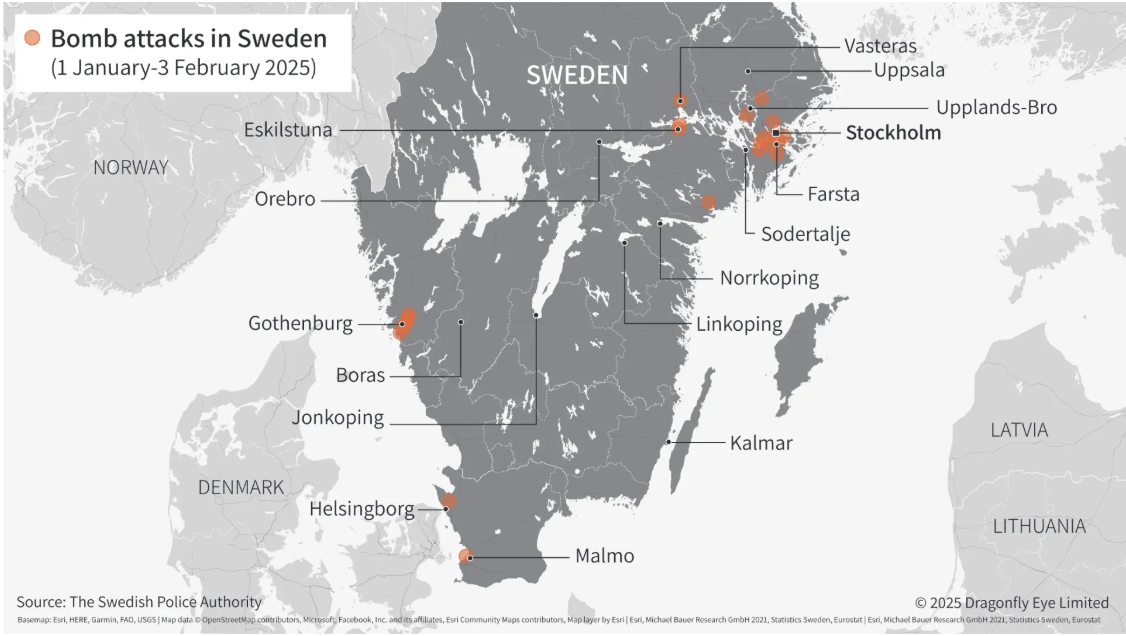
The transformation is most visible in the intensifying competition between rival gang hierarchies. Among the most prominent networks are Foxtrot, led by Rawa “the Kurdish Fox” Majid, Rumba, led by Ismail “the Strawberry” Abdo, and Dalen, controlled by Mikael Tenezos and tied to Mexico. While Stockholm is the epicenter, this conflict is the product of networked rivalries that cross cities. Foxtrot is considered to be the most violent and carried out several attacks per month in 2025 to enforce its dominance in the drug market. Dalen has been expanding, while Rumba weakened following the arrest of Ismail Abdo in Turkey. Despite arrests and less violence in 2024, attacks rose again in 2025, especially after Rawa Majid’s uncle was killed under police protection. Johan Olsson, head of the police’s National Operational Unit, pointed out that gangs still have easy access to weapons and to online recruits who show willingness to carry out attacks. The system that produces violence thus remains untouched.
As Tam Hussein notes, bombings, shootings, and contract killings have become routine enough in parts of the country that residents have grown indifferent to crime scenes. Sweden’s position between Scandinavia and continental Europe, with transit funneled through Malmö’s Øresund Bridge and eased by Schengen, has made it a corridor for drugs and weapons. International criminal networks rely on Swedish gangs as local operators, and young recruits, sometimes minors, are hired to kill because the legal and social costs are low. Teenagers below 15 cannot be convicted for a crime, and those aged 15-17 rarely receive custodial sentences except for the most serious offenses. In Sweden’s suburban areas, where most recruitment happens, alternative livelihoods are scarce due to high unemployment and child poverty, and low school attendance and performance.
Even with an EU-level task force targeting Foxtrot, Swedish police are met with silence in communities affected by gang violence. This is produced by fear of retaliation and the perception that gang connections are widespread. Gangs exercise control through attacks and, most importantly, through the constantly looming threat of such. Gang violence can also destroy information, as gangs kidnap or kill witnesses before they can speak. Violence, therefore, is a form of coercion that sits between crime and politics and is used to instill fear and structure behavior.
Moreover, although it is still tied to profit and intimidation, violence has acquired a reputational function. It is characterized by a logic of honor, retaliation, and status among networks. Bombings and killings are means or currency because they increase reputational capital, which reinforces deterrence and influence. By establishing who can credibly threaten, punish, and enforce, violence helps structure hierarchies and allocate power toward gangs at the expense of state institutions.
This is what complicates traditional law-enforcement. The Swedish state interprets violence through the drug market’s logic and classifies it as organized crime. Prime Minister Ulf Kristersson’s language reflects the problem. He speaks of shootings as a technical issue, something to be managed through police capacity, even while admitting that it is “not over.” This managerial response mischaracterizes violence as a disorder instead of a substitute governance structure. Violence is the product of enforcement gaps that persist regardless of longer sentences or military deployment. Addressing it requires naming the underlying conditions that make gang authority legible to marginalized communities.
The means to tackle the issue have nonetheless converged on repression rather than prevention, which is insufficient. At a political level, most parties still agree on having harsh criminal policy and compete for who can be tougher. But those closest to the violence understand that repression has strategic limits. Gang members are generally indifferent to longer sentences because life expectancy inside their world is already low, and prison does not disrupt the system so much as rotate its personnel. Younger recruits quickly replace jailed gang members. Police argue that their work depends on social services having the capacity to intervene early, yet these sectors are underfunded. The state invests heavily in punishment but neglects the social structures that shape who becomes violent in the first place. This has created a cycle where repression manages violence without changing the conditions that produce it. State intervention has only addressed the outputs while leaving the architecture intact. The network of threats, silence, and dependence still organizes daily life in affected communities.
Credit: Dragonfly Eye Limited
Gambetta and the economy of reputation
The interaction of violence, reputation, and protection in Sweden can be interpreted through Diego Gambetta’s The Sicilian Mafia: The Business of Private Protection. Gambetta distinguishes between the market for illicit goods and the market for protection. In the former, gangs are sellers of a commodity; in the latter they are guarantors, actors who sell the assurance that transactions will be honored and disputes resolved. Gambetta’s central argument is that the mafia’s main business is the second, enforcement capacity, which is what allows them to consolidate power. Drug markets generate revenue, but they do not explain why violence is public, cyclical, and strategic. Gangs compete over the capacity to enforce agreements and punish defection in the absence of reliable state arbitration. Protection is a scarce good because transactions depend on credible enforcement, and credibility rests on the threat of violence.
Within this market, risk is unevenly distributed, and enforcement is supplied privately, making reputation a central mechanism. Actors must be perceived as willing and able to enforce, otherwise their protection loses value. It is insufficient to claim strength, particularly in a rivalrous environment where each has an incentive to claim strength and little to lose from doing so. Therefore, given that perception is inherently flimsy and discrediting claims of strength can hurt their reputation, gangs are constantly pressured to signal their credibility. Violence serves that purpose, as it is a costly signal that is difficult for rivals to feign. Competition thus rewards those who exhibit toughness over restraint. As Ben Lessing, professor at the University of Chicago, argues in Making Peace in Drug Wars, violence is better understood as a tool of coercive bargaining, which is used to influence outcomes by demonstrating willingness to act. Extending that logic to inter-gang competition, violence clusters around power transitions or moments where enforcement credibility is most in question. Among these are the arrest of a leader or key member, the opening of a new market or route, the increase in clients, or contestatory acts carried out by rivals
Applied to Sweden, this framework should help explain why violence has been cyclical and persistent without any gang being able to sustain durable governance. Swedish gangs compete in a fragmented enforcement environment where credibility must be repeatedly demonstrated. Violence is used less to stabilize control than to verify that a group remains capable of enforcement when reputational authority cannot be relied on over time. Public shootings and bombings are acts of authentication and contestation—that is, tools for distinguishing credible enforcers from weaker ones. In doing so, they reveal how protection itself becomes a commodity, which reorganizes social relations in ways that cannot be reduced to generic criminal proclivities or cultural failure. In Sweden, the market for protection is unstable, and the state is seen as an unreliable enforcer in marginalized communities. This makes gangs use violence episodically to strengthen their reputation, signal their presence, and express their willingness to sustain credible enforcement relationships.
The logic describes a spectrum between open conflict and monopoly, neither of which is a stable equilibrium. Gangs competing in the same territory push toward consolidation, since a single dominant enforcer can stabilize transactions, reduce contestation, and redirect resources against the state. But monopoly, if achieved, generates instability too because the relative quiet that follows consolidation is misread by rivals as complacency, creating the incentive to challenge the monopoly. Enforcement should ideally operate through deterrence alone—that is, protection succeeds precisely when there is no further violence—but silence is what makes authority look fragile to other competing gangs. Protection cannot become a passive, long-term investment and must be continuously asserted. Gangs thus know that monopolies are temporary and contestable, and their rational response is to keep signaling strength visibly and repeatedly. Restraint reads as weakness, which invites challengers, and the incentive structure therefore pushes for constant, public violence regardless of where a gang stands on the spectrum.
This is precisely what distinguishes the Swedish case from Gambetta’s Sicilian case. In Sicily, the state was largely absent, which meant that enforcement could gradually be territorialized, reputations could be inherited, and monopolies could be defended over time. In Sweden, consolidation is impossible because state intervention prevents the inheritance and organization of reputation. The Swedish state, despite its misreading of the problem, incarcerates members, dismantles networks, and intervenes through the military, which disrupts consolidation. However, it still leaves gaps such as chronic unemployment and underfunded state services, which in turn make the economic and social rewards of joining a gang more appealing for young recruits. This hybrid condition produces competition without stabilization, amplifying violence rather than suppressing it. Under these conditions, restraint loses its strategic logic because it is only rational when a gang can expect its dominance to persist long enough to make stability worth protecting. When leadership constantly rotates and reputational authority cannot be inherited or institutionalized, that expectation vanishes and with it, any incentive to hold back.
Diego Gambetta also observed that Sicilian organized crime gradually separated “hard core” enforcers from ordinary traffickers. Enforcement could be delegated to a separate class of specialists, so that reputational capital could be institutionalized. This reduced violence by embedding enforcement capacity in organizations rather than individuals, which in turn reinforced threats of retaliation without the need for repeated and visible violence. This is what would allow a protection market to stabilize. In Sweden, however, that separation of roles has not happened. Individual actors combine trafficking and enforcement, leadership is personal and subject to replacement, and transnational supply chains are handled by external networks with their own infrastructure. Such conditions reduce the incentive to invest in institutionalized enforcement locally and make specialization costly or infeasible. Enforcement stays transactional rather than structural, which makes recurrent, public violence the only rational mechanism to build credibility.
Nonetheless, even if Sweden saw the establishment of a monopoly, it would not be positive news. A consolidated criminal monopoly could, in principle, reduce contestatory, public violence by substituting reputation and arbitration for continual authentication. It would also mean the state has failed in its role of legitimate provider of security and arbitration within its own territory and jurisdiction. Beyond the political failure and the reduction of conflict between actors, consolidation would bring long-lasting, coercive authority, widespread extortion, and deep entanglement with local institutions. Both open competition and monopolistic consolidation are different failure modes; the first being loud and visible, and the latter far harder to dismantle.
Conclusion
Sweden’s gang violence is not a crime wave that better policing will eventually eliminate. There is an enforcement gap that the state has consistently failed to close, and which gangs have filled with coercive authority of their own and with economic rewards for young recruits. Sicily’s example illustrates the starkest endpoint of failure, where protection markets consolidate and replace the state as the legitimate provider of enforcement. Although Sweden is not Sicily, Gambetta’s framework reveals why standard responses, such as state repression, have not properly addressed the market for protection, which is why the underlying demand for enforcement in marginalized communities has remained largely intact. What the Swedish case reveals is that violence of this kind cannot be read as mere criminality or cultural dysfunction. It follows a coherent institutional logic that will persist as long as the conditions that make that logic rational remain intact. Through this logic, credibility is claimed and lost faster than it can be institutionalized, which is why violence is visible and cyclical rather than turning into stable governance. The state intervenes often enough to prevent gangs from consolidating, but not consistently enough to become the credible enforcer communities need.
The path forward should be a reorientation of what the state is actually competing for: the loyalty and institutional legitimacy that gangs currently provide. Reducing gang authority requires making it less credible, which means investing in early intervention, stable social services, and economic alternatives in the communities where recruitment often happens. These are not just welfare measures in the standard sense because they also serve as the core of a security strategy, where the state invests less in punishment and more in prevention. The goal is making the market for private protection less necessary in the first place.