

Current Sino-Russian Bilateral Relations and the Near Future
Written by Jipson Zhang; Edited by Andrew Ma
December 8, 2025
Background
The rise of major bilateral relations between China and Russia could be traced back to China’s century of humiliation, when Russia forced unequal treaties upon the Qing. The rise of Mao and the communists’ effort to overturn the unequal treaties caused tensions to rise between the Soviets and the Chinese that eventually led to the Sino-Soviet split. After the collapse of the Soviet Union, Sino-Russian relations saw a pragmatic reset. As we enter the 21st century, we now live in the height of Sino-Russian relations, as both see a convergence to oppose the American-led post-war liberal order.
Economic Statue
The basis of the Russian-Chinese economic relationship could be viewed through the lens of Russia needing consumer goods, while the Chinese need Russian resources. This relationship should be viewed as complementary rather than competitive. This relationship should, however, not be viewed as completely equal. China is Russia’s largest trading partner, while Russia is only a mid-level partner for China.
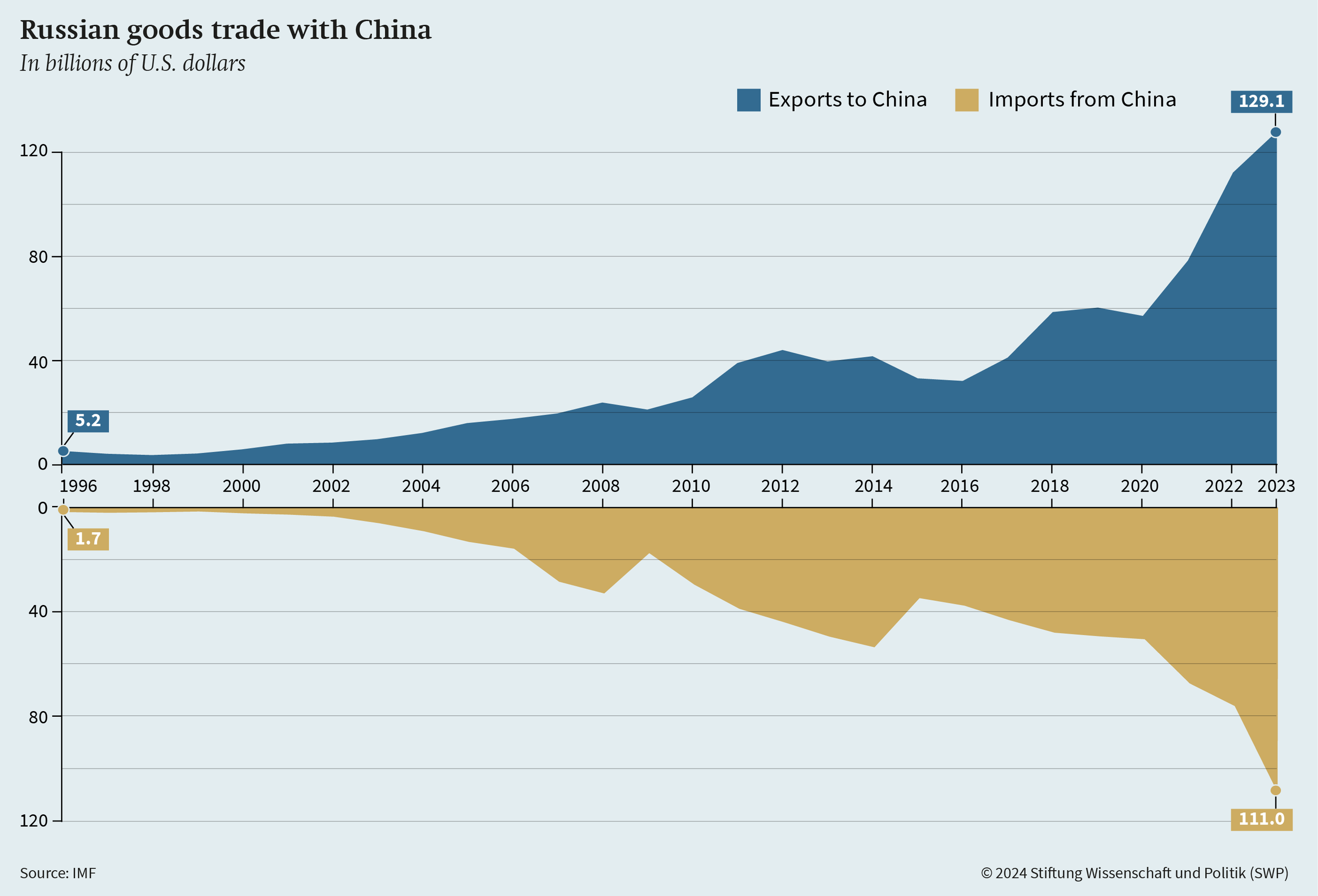
China’s share in Russian goods trade, 1996–2023. Source: Stiftung Wissenschaft und Politik (SWP), “China’s Share in Russian Goods Trade,” 2024; data from IMF, Chinese customs, and Russian customs.
The lynchpin of this Sino-Russian economic relationship lies in the energy trade. The Chinese would like to develop their “hub-and-spoke” patterns of influence in their global economic interactions, especially in the energy sector. Russian hydrocarbon provides a vital continental supply of oil and gas that is disconnected from sea routes, where American naval dominance will pose a threat. For Russia, Chinese demand provides a stable and indispensable market after losing the European markets post-invasion of Ukraine in 2022. Chinese finances have been vital to Russia’s fiscal stability, staving off hyperinflation of the ruble, where the Russian state had to borrow more and more to fund its war in Ukraine.
Beyond the energy trade, China has become increasingly important to Russia in technology and finance as well. With Western firms exiting Russia post-2022 invasion and sanctions severing Russian access to advanced hardware, Russian domestic industries have turned to Chinese companies for electronics, telecommunications equipment, industrial machinery, financial channels, and more. Russia has increasingly grown reliant on Chinese banking networks, even more so after 2022. China, in turn, however, does not meaningfully depend on any Russian technological inputs in its domestic industry (see Security Status section on defense technological exchange). Thus, while both countries frame their relationship as one of equals resisting Western dominance, the realities show that Russia is increasingly subordinated to Chinese capital and technology, a development that many Russians in the security circles are concerned about.
Diplomatic Status
Sino-Russian diplomacy today is shaped by a mixture of geopolitical strategic alignment against the West and a deepening but asymmetrical interdependence in economic matters. While Moscow and Beijing frame the relationship as a partnership of equals, the diplomatic reality between the two reflects an imbalance in which China increasingly sets the terms, and Russia increasingly compromises to them.
Since the early 2000s, Beijing and Moscow have coordinated closely in the UN Security Council, vetoing Western-backed resolutions and consistently defending what they espouse as principles of state sovereignty and non-intervention. This “partnership” in the UN and on foreign policy matters reflects a “geostrategic axis” of an anti-interventionist philosophy shared by both governments (or at least what they proclaim). Many in the Russian elite view China as an essential partner for balancing Western pressure, even as they quietly worry about China’s rising power, which puts their relationship at an alarming imbalance.
The first Russian incursion into Ukraine in 2014 and the Western reaction that followed pushed Moscow further into Beijing’s diplomatic orbit. China used this diplomatic opening by integrating the Russian position into Xi’s broader “major-power diplomacy (大国外交)” agenda for China. The February 2022 statement about their “no limits” relationship further solidified this new alignment between the two countries. China’s refusal to condemn Russia for its 2022 invasion of Ukraine, as well as its support for the Russian narrative on the root cause of the war, further demonstrates this diplomatic alignment, even if it might compromise China’s own relationship with the West.
It is however important to note that this partnership is not an alliance. There is no mutual defense treaty between the two (unlike Russia and North Korea), and Beijing is careful not to incur secondary sanctions from Europe and the US. Many analysts today characterize the relationship between China and Russia as strictly a strategic alignment of convenience. China benefits from a Russia that challenges and directly confronts the West; Russia benefits from Chinese political and economic protection. It is once again very important to note that Moscow’s dependence on China is far greater than vice versa.
Cultural Status
Despite close alignment and cooperation in the field of economics and diplomacy, the cultural dimension of the Sino-Russian relationship remains strained. Cultural perceptions and opinions by the general populace have not kept pace despite many state-to-state government-to-government interactions. Much of this could be attributed to limited people-to-people integration and anxieties rooted in perceptions shaped by historical experience.
One of the most enduring cultural and strategic concerns in Russia is the presence of large numbers of Chinese migrants living and working in the Russian Far East. Although the actual Chinese population in the region is dependent on seasonal labor flows, Russian public discourse has long imagined a “Chinese demographic invasion.” There is actually no reliable public data that credibly shows the current number of Chinese people living in the Russian Far East. Most estimates for the Chinese population vary widely, and many are outdated or contested. What makes this number even more difficult to pinpoint is the rise in relative prosperity of China compared to that of Russia. The best estimate we have for temporary Chinese workers today, including European Russia, is between 400,000 and 550,000, and that estimate is almost a decade old.
Culturally, Chinese migrants have rarely been fully accepted into Russian society. Sociological studies throughout the 2000s–2020s show that racialized stereotypes of Chinese people as “invaders,” “opportunists,” or “disease carriers” remain common among the local and general Russian population. Russian media have periodically stoked fears of “yellow peril” narratives that further compound this stereotype. Polls conducted recently consistently show that while national elites praise cooperation with China, ordinary Russians still express limited favorability and trust towards the Chinese as a people.
Security Status
The security dimension of the Sino-Russian relationship is perhaps the most consequential relationship for the US and its allies. Yet, as with the diplomatic and economic dimensions, it remains deeply asymmetric.
Russia today is increasingly becoming dependent on Chinese non-lethal dual-use support to its war in Ukraine. This support is what some have called “selective security support,” which includes critical drone components, microchips, navigation tech, and other military-related goods. China has avoided direct lethal aid to evade secondary sanctions but still acts as Russia’s strategic enabler in Ukraine.
One could argue that China has gained more from the partnership than Russia has from Russian military technology transfers. Today, the Chinese military is, in large part, technologically self-sufficient and in several areas even technologically superior to Russia. While Beijing no longer relies on Russian avionics, missiles, or sensors, Russia has become increasingly reliant on Chinese dual-use electronics for its war in Ukraine. What we see today is almost a complete reversal of what we have seen since the 1990s. China’s military-industrial base is now peer-competitive with the U.S. in some domains, while Russia’s has stagnated. What began as a relationship of security dependence has now evolved into one of asymmetry. Today, China has emerged not only independent of Russian technology but increasingly a net provider of the critical components to Russia that are required to sustain its own war-fighting capability.
Forecast
Looking ahead in the next three years, I forecast the core trajectory of Sino-Russian relations is likely to be shaped less by sentiment or any special affinity but more by structural constraints created by the war in Ukraine. In the near to medium term, I would expect continued cooperation under conditions of deepening asymmetry that so defined their relationship in the last 10 years. Russia will be increasingly dependent on Chinese capital, technology, and markets as long as major Western sanctions remain in place. Beyond the outcome of the war in Ukraine, the war itself will determine whether Moscow can claw back strategic autonomy from Beijing or drift into a more clearly subordinate role within a loose Chinese-centered bloc.
If the war in Ukraine continues in its current high-intensity fighting form at the front with no decisive breakthrough, most evidence points to continued and even intensifying Sino-Russian cooperation under asymmetric conditions. Western sanctions and export controls are already pushing Russia to rely on China for everything from consumer goods and dual-use electronics to financial infrastructure and banking. Chinese exports to Russia have risen by more than 70 percent since 2021, and Beijing has become indispensable to keeping segments of the Russian war economy functioning and preventing it from collapsing.
As long as the war drags on and the West maintains its sanctions (or even raises sanctions), Russia has few alternatives. As long as major sanctions remain in place, Russia will be structurally dependent on China for markets, technology, and diplomatic cover for the foreseeable future, and the asymmetric power gap between them will continue to widen. In this scenario, the current pattern of a quasi-alliance with clear Chinese primacy continues.
If Russia were to achieve something it can plausibly present to its populace and world as a victory by forcing Kyiv into an unfavorable settlement, the political dynamics of the Sino-Russian relationship could shift. A more confident Kremlin might first seek partial normalization with Europe (as they did post-Crimea) to reduce sanctions pressure and regain access to Western capital, technology, and markets. The Kremlin might reassert Russian strategic independence by once again resisting Chinese economic and diplomatic overreach in the Russian Far East and Central Asia, which they have turned a blind eye to since the war in Ukraine began.
Russia would likely try to regain room to maneuver between China and the West in the event of victory. Years of heavy reliance on the Chinese would heighten elite awareness of the risks of junior-partner status, prompting efforts to push back against Chinese influence in Russian affairs. This forecast scenario is, however, dependent upon the speed of Western capital and technology returning (if returning at all). If Europe is committed to long-term energy diversification and independence from Russia, economic damage from sanctions will not be easily reversible. As a result, a more confident Russia might behave more independently, but would still remain materially tied to China. This evolution in their relationship will be somewhat less asymmetric, though still far from equal.
If Russia loses the war and faces a strengthened and united NATO, I forecast the partnership with China will shift decisively. A defeated Russia would have little bargaining power with the West for sanction relief or reintegration back into the Euro-Atlantic system. With the loss of the war, Putin will have problems confronting domestic legitimacy concerns. Russia would be driven to intensify its anti-Western narrative and rely even more on China for diplomatic, economic, and technological support.
In this context, Moscow’s dependence on China would deepen across multiple domains, from defense-industrial cooperation to sanctions-evasion networks. Expanded Chinese influence in Russia’s energy and infrastructure sectors in Siberia will continue. Beijing, in turn, could demand preferential access to Russian and Central Asian resources, or even equity stakes in strategic Russian assets, as the price of sustaining the relationship. Over time, this dynamic could push the partnership beyond today’s informal “soft alliance” toward a formal “quasi bloc” aimed at counterbalancing the United States and its allies. The result would be greater strategic leverage for China and even a great loss of autonomy for Russia.
