
What is Türkiye Doing in Libya: A Case Study
By Semih Beren
On November 27, 2019, Türkiye and the Tripoli-based Libyan Government of National Accord signed two memoranda within a 12-hour period: a security cooperation agreement and a declaration of maritime boundaries in the Eastern Mediterranean. This sequence of events in Turkish foreign policy exemplifies President Süleyman Demirel’s iconic statement that “24 hours is a long time in Turkish politics.” After 2011, Libya was perceived as an unmanageable failed state: a divided nation between competing regimes, backed by foreign actors, and a game of geopolitics was being played over Africa’s greatest proven oil reserves. And within this complex status quo, Türkiye intervened.
Türkiye’s involvement in Libya is an example of a Gordian knot approach to foreign policy: instead of attempting to untangle the region’s complex pre-existing dynamics, Türkiye cut through the Gordian knot, decisively reshaping the status quo to serve its own strategic interests. By examining Türkiye’s military mission, maritime memorandum, realpolitik perspective, and economic and diplomatic consolidation, this paper demonstrates how Ankara transformed a collapsing partner into an enduring strategic asset.
Background
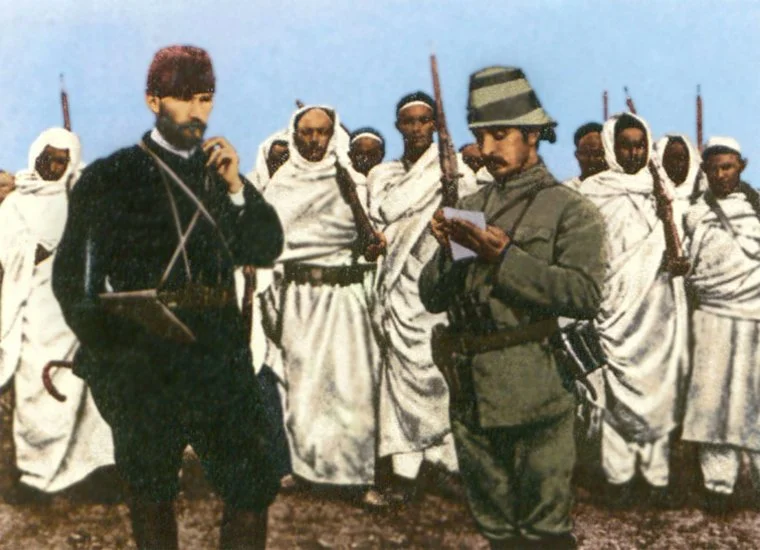
Source: Wikipedia
Türkiye and Libya’s relationship predates the Westphalian state system. From 1551, the territories that now comprise modern Libya were incorporated into the Ottoman Empire, sharing over 360 years of socio-political history with what would become the Turkish Republic. The 1911 Italo-Turkish War further deepened this shared history. Mustafa Kemal Atatürk, the founder of modern Türkiye, served as a volunteer in Libya, where he organized asymmetrical warfare against Italian colonial forces and gained firsthand experience in unconventional tactics. The Libyan campaign taught Mustafa Kemal how an outnumbered force could offset an opponent’s military superiority by withdrawing into the interior, mobilizing local support, and stretching enemy supply lines, principles that would later shape his conduct during the Turkish War of Independence.
The longstanding historical relationship between Türkiye and Libya persisted into the period of modern nation-states. In 1974, Libya was among the few countries to openly support Türkiye’s military intervention in Cyprus. During Türkiye’s period of international isolation, these enduring ties helped Libya emerge as a significant market for Turkish economic investment, particularly in construction and trade networks. In this sense, Türkiye’s intervention in 2019 was not an entry into unfamiliar territory but rather a return to a region with which it had longstanding connections.
The Status Quo in Libya
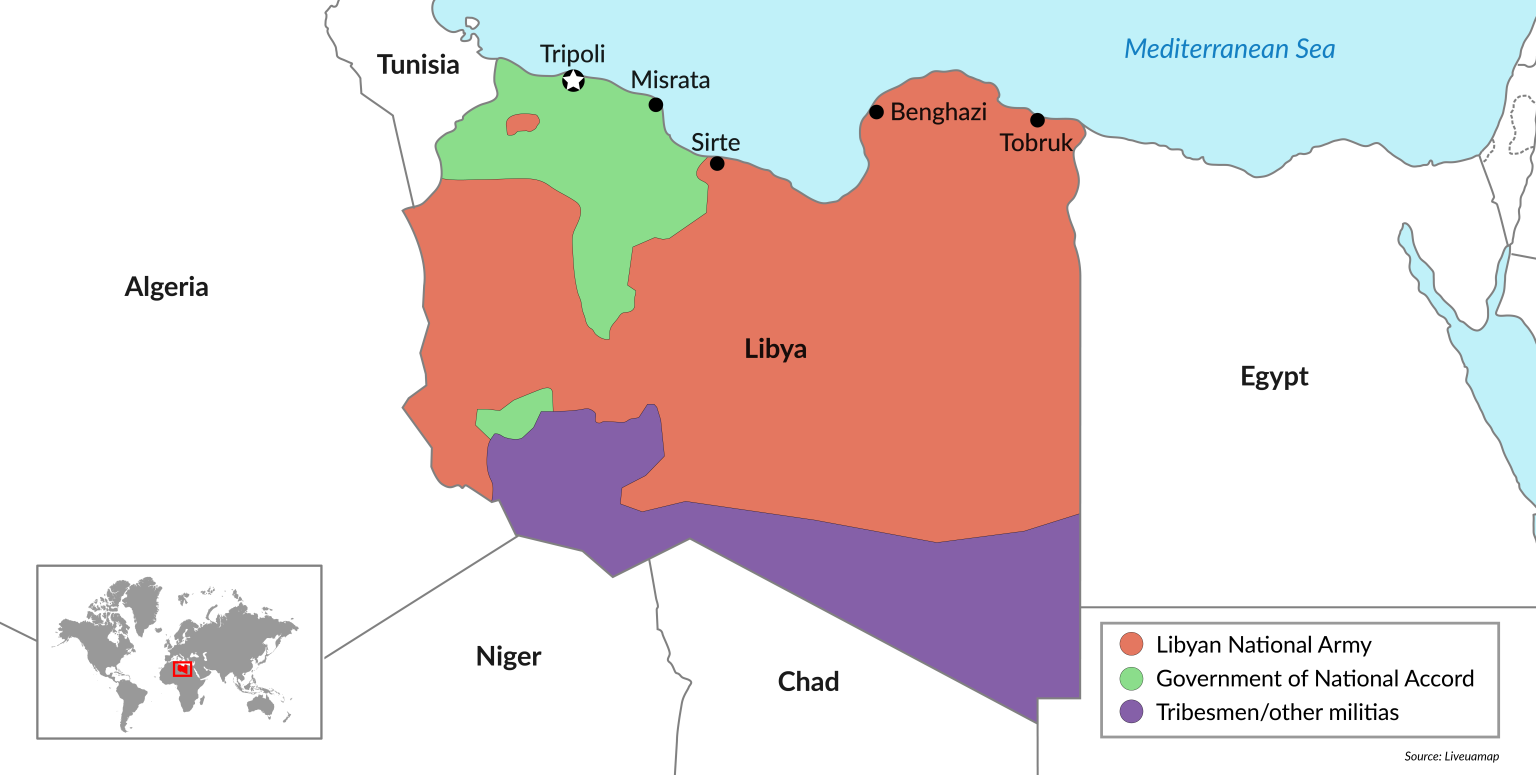
Source: GIS Reports
As of April 2026, Libya remains a deeply divided state, split between two rival centers of authority. The internationally recognized government in the west is the Government of National Unity (GNU), led by Prime Minister Abdul Hamid Dbeibah and based in Tripoli. In the east, Field Marshal Khalifa Haftar, through the Libyan National Army (LNA) and parallel state institutions backed by the Tobruk-based House of Representatives, maintains authority. Although neither side has the strength to unify the country, both possess enough military and financial power to block any resolution that threatens their position, resulting in a frozen stalemate. This political division is reinforced by geography and tribal structure. Libya’s three historical regions of Tripolitania, Cyrenaica, and Fezzan have never been truly unified, and real political loyalty follows clan and militia lines rather than national institutions. Much like the Gordian knot of ancient legend, Libya’s interlocking crises had resisted every attempt at resolution. Türkiye’s response was not to untangle them; it was to cut through them with military power to create a new reality on the ground.
Military Intervention
Türkiye’s military involvement in Libya predates 2019. As early as 2014, Ankara joined an international effort alongside the United States, the United Kingdom, and Italy to establish a General Purpose Force in support of the Tripoli-based government, a limited mission with no long-term strategic commitment. By 2019, however, the situation had changed dramatically. As Haftar's Libyan National Army, backed by Russia, advanced on Tripoli, and the Wagner Group-a Kremlin linked mercenary company coordinating tightly with the UAE deployed hundreds of fighters south of Tripoli in September 2019, the balance of power shifted decisively against Turkish interests. Turkish-Russian relations were already tense over Syria, and Ankara recognized that Libya presented a dual strategic objective: preserving a critical strategic partner while simultaneously undermining Russian and Emirati ambitions in North Africa and the Eastern Mediterranean. Thus, on January 2, 2020, the Turkish Parliament approved a resolution authorizing the deployment of Turkish forces to Libyan soil.
The Turkish military mission’s objective was to establish military superiority in Tripolitania, ensure the GNA’s survival, and safeguard the balance of power in Libya in favor of Turkish interests. Ankara’s strategy combined advanced air power, layered air defense, and reinforced ground forces to decisively shift the course of the war. Turkish forces introduced Bayraktar TB2 armed drone systems as the operational centerpiece, supported by HAWK MIM-23 medium-range and KORKUT short-range air defense platforms to protect GNA-held airspace. MILKAR-3A3 V/UHF electronic warfare systems intercepted and jammed enemy communications and targeting, while T-155 FIRTINA and BORAN howitzers alongside TRG-300 TIGER tactical missiles provided sustained firepower, supported on the ground by between 3,500 and 3,800 Syrian mercenaries according to Pentagon sources, providing the manpower that proved critical. The most consequential element of the deployment was the Joint Command Center, where senior Turkish officers assumed direct operational command on the ground. The deployment of Bayraktar TB2 drones ultimately proved decisive in halting Haftar’s Operation Flood of Dignity by mid-2020, demonstrating the operational effectiveness of Türkiye’s intelligence-based drone warfare doctrine on a global stage.
Turkish Doctrine
Türkiye’s intervention in Libya is rooted in a broader security doctrine that extends well beyond Libya itself. Defense analysts contend that Ankara’s security doctrine is based on the premise that Türkiye cannot be adequately defended from within its own borders, given the multiple vulnerabilities of the Anatolian heartland. As a result, Ankara invests in forward positions in Syria, Cyprus, and Libya to deter potential threats from its core territory, projecting power through proxies and cross-border operations rather than relying solely on conventional defense. Within this framework, Libya serves as the southwestern anchor of Turkish national security doctrine.
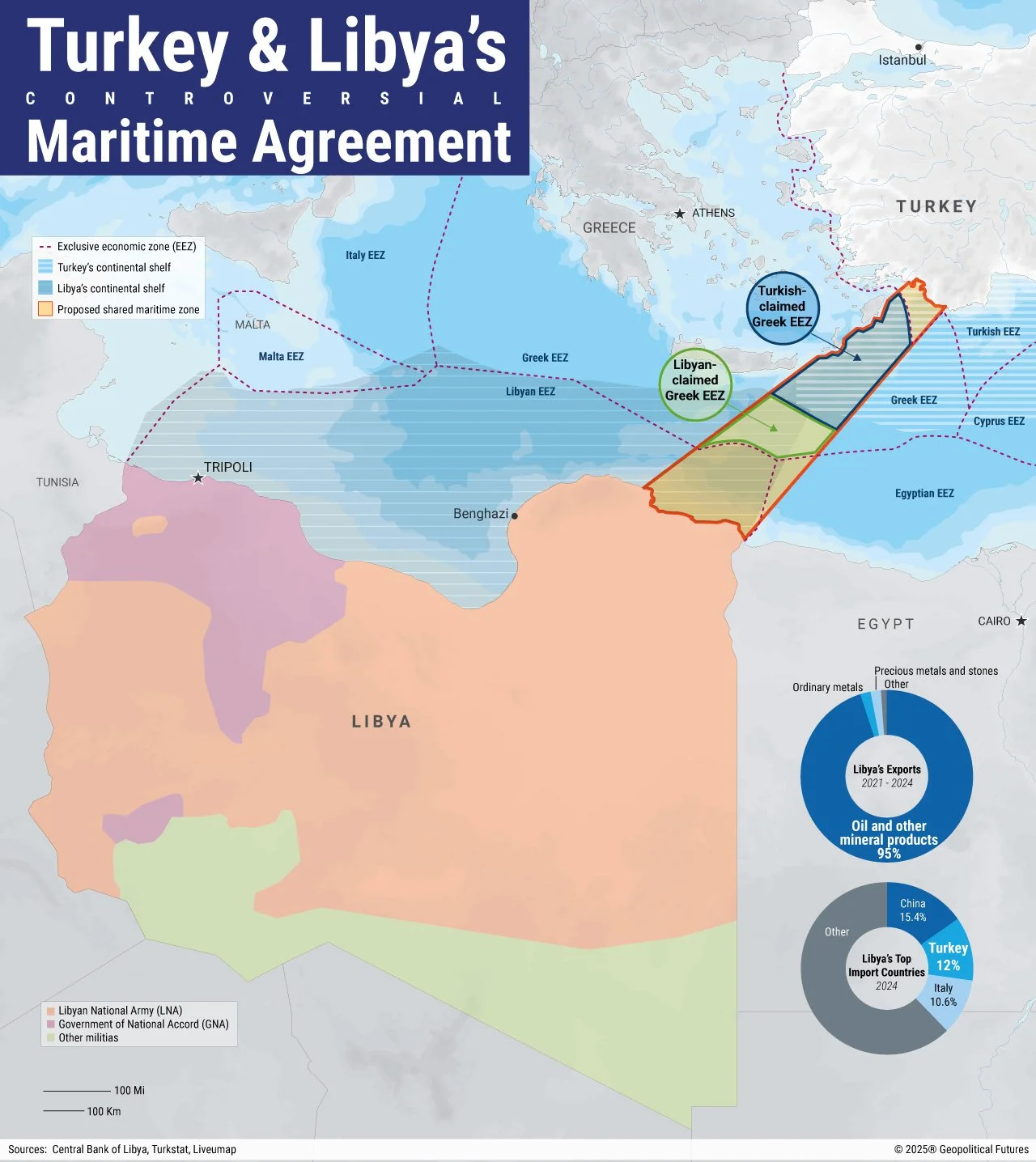
Source: Geopolitical Futures
Türkiye’s intervention in Libya was not limited to ground operations; it extended into the maritime domain. The Mavi Vatan, or “Blue Homeland,” doctrine is the strategic framework behind Türkiye’s maritime objectives in the intervention. First formalized by Admiral Cem Gürdeniz in 2006, the doctrine asserts Turkish jurisdiction over approximately 462,000 square kilometers across the Black Sea, the Aegean, and the Eastern Mediterranean. Its core objective is energy independence and freedom of action at sea, without dependence on third parties. This doctrine emerged from a deeply militarized dispute over Aegean naval rights, airspace sovereignty, and continental shelf delimitation issues that have long defined Turkish maritime sovereignty concerns. The 2019 maritime memorandum was the direct application of Mavi Vatan, projecting Türkiye’s maritime claims into the central Mediterranean through its partnership with Libya.
The November 27, 2019, maritime memorandum with the GNA was Ankara’s first major step toward achieving Mavi Vatan objectives. The agreement established a bilateral maritime boundary between Türkiye and Libya, intentionally excluding the exclusive economic zone and continental shelf entitlements of Greek islands within the disputed area. This maritime delimitation, however, reflects Türkiye's interpretation of maritime law rather than the universally accepted standard set by the 1982 United Nations Convention on the Law of the Sea (UNCLOS), to which Türkiye is not a party. Ankara declined to sign or ratify the convention because its treatment of islands, which grants them full exclusive economic zone and continental shelf entitlements, would severely restrict Turkish maritime rights in the Aegean and Eastern Mediterranean and erode the territorial balance Türkiye secured under the 1923 Treaty of Lausanne. Türkiye maintains instead that maritime boundaries should follow a median line drawn roughly halfway between the Greek and Turkish mainland coasts, discounting the entitlements that Greek islands would otherwise generate.
The 2019 memorandum was a direct application of this principle. The result was significant; the new boundary created a Turkish-Libyan maritime corridor across the Eastern Mediterranean, cutting through competing Greek, Cypriot, and Egyptian continental shelf claims and intersecting established energy exploration zones. The international reaction was swift and unified. Greece, Cyprus, France, and Egypt condemned the memorandum as illegal, arguing it violated international maritime law and their sovereign rights as third parties. In August 2020, Greece signed a counter-maritime delimitation agreement with Egypt in response. When Türkiye began drilling in the contested zones, the European Union imposed sanctions on Turkish officials in response. As of 2026, the memorandum remains in force, and all maritime and energy negotiations in the Eastern Mediterranean continue to operate under the framework that Türkiye unilaterally established in 2019.
However, the memorandum's persistence should not be read as its international acceptance. The memorandum remains in force because Ankara has sustained the balance of power needed to uphold it; most of the actors it affects continue to reject it outright. This Memorandum carried real costs for Türkiye It draw Greece, Cyprus, Egypt, and at times France into closer cooperation Against Türkiye contributing to Türkiye’s exclusion from regional energy structures such as the East Mediterranean Gas Forum In this sense, the 2019 memorandum reveals both the reach and the limits of the Gordian knot approach: Türkiye could force a new reality on the ground, but it could not make that reality legitimate by itself.
Current Turkish Military Footprint in Libya
In December 2025, Türkiye’s parliament approved a further 24-month extension of its military mandate in Libya, authorizing the deployment through 2028. As of 2026, the Libya deployment stands as one of Türkiye’s largest active foreign military missions. Türkiye’s personnel, with open-source estimates placing the total at approximately 3,000 personnel (including roughly 2,200 military personnel and around 800 contracted support staff), are stationed at multiple locations, including Al-Watiyya Air Base, the Misrata naval base, Mitiga Airport, the Tajoura Land Training Center, and the Khoms Special Forces Center. Open-source reporting also indicates a limited Turkish naval presence in the central Mediterranean in support of Libya-related operations, though exact deployment patterns are not publicly confirmed. Open-source reporting further indicates that Turkish naval vessels have conducted periodic port visits to Libya, reflecting a broader pattern of maritime engagement linked to Ankara’s security and cooperation framework with Libyan authorities, although exact operational details remain undisclosed.
What began as an emergency intervention has shifted to training, advisory support, and stabilization, given the ongoing failure to achieve a permanent ceasefire or unified Libyan institutions. Türkiye’s mission has since recalibrated into active diplomatic engagement across Libya’s divided factions. Ankara has taken a pragmatic approach, moving well beyond its original western alignment. In 2024, Türkiye initiated a back-channel diplomatic effort by arranging communication between Minister Emad Trabelsi and Saddam Haftar, son of Khalifa Haftar, during the Saha Defense Expo in Istanbul. This ongoing Türkiye-facilitated diplomacy enabled both rival factions to begin direct dialogue, positioning Ankara as the primary mediator between the GNU and the LNA. Ankara pursued direct engagement with eastern Libyan actors, with Saddam Haftar visiting Türkiye three times in 2025 and the Turkish intelligence chief traveling to Benghazi, marking the first high-level Turkish contact with the eastern administration in years. Ankara has positioned itself as a vital partner and mediator for both sides of Libya. The Flintlock 2026 exercise, led by the United States and supported by Türkiye, represented a significant milestone. Held in Sirte in April 2026, it brought together forces from both the GNU and the LNA for their first joint exercises. This unprecedented cooperation was made possible by Türkiye’s back-channel diplomacy and sustained strategic military deployment.
Conclusion
In conclusion, Türkiye’s Libya policy exemplifies the principle of cutting the Gordian knot rather than attempting to navigate the conflict’s intractable complexity. Ankara cut through it with military intervention and shaped the reality on the ground to serve its own interests. Türkiye did so by deploying military force, asserting maritime claims when the diplomatic window opened, and expanding its engagement with eastern Libyan actors when the frozen conflict created new opportunities, becoming the strongest mediator between the two sides. In this sense, the Gordian knot was not untangled, it was cut. Türkiye’s Libya intervention demonstrates that regional powers, not only global ones, can decisively reshape frozen conflicts through a Gordian knot approach.