

A Worthy Gamble? Evaluating the Impact of the 2025 U.S. Bailout of Argentina
Written by Maya DeAndrea; Edited by Andrew Ma
March 15, 2026
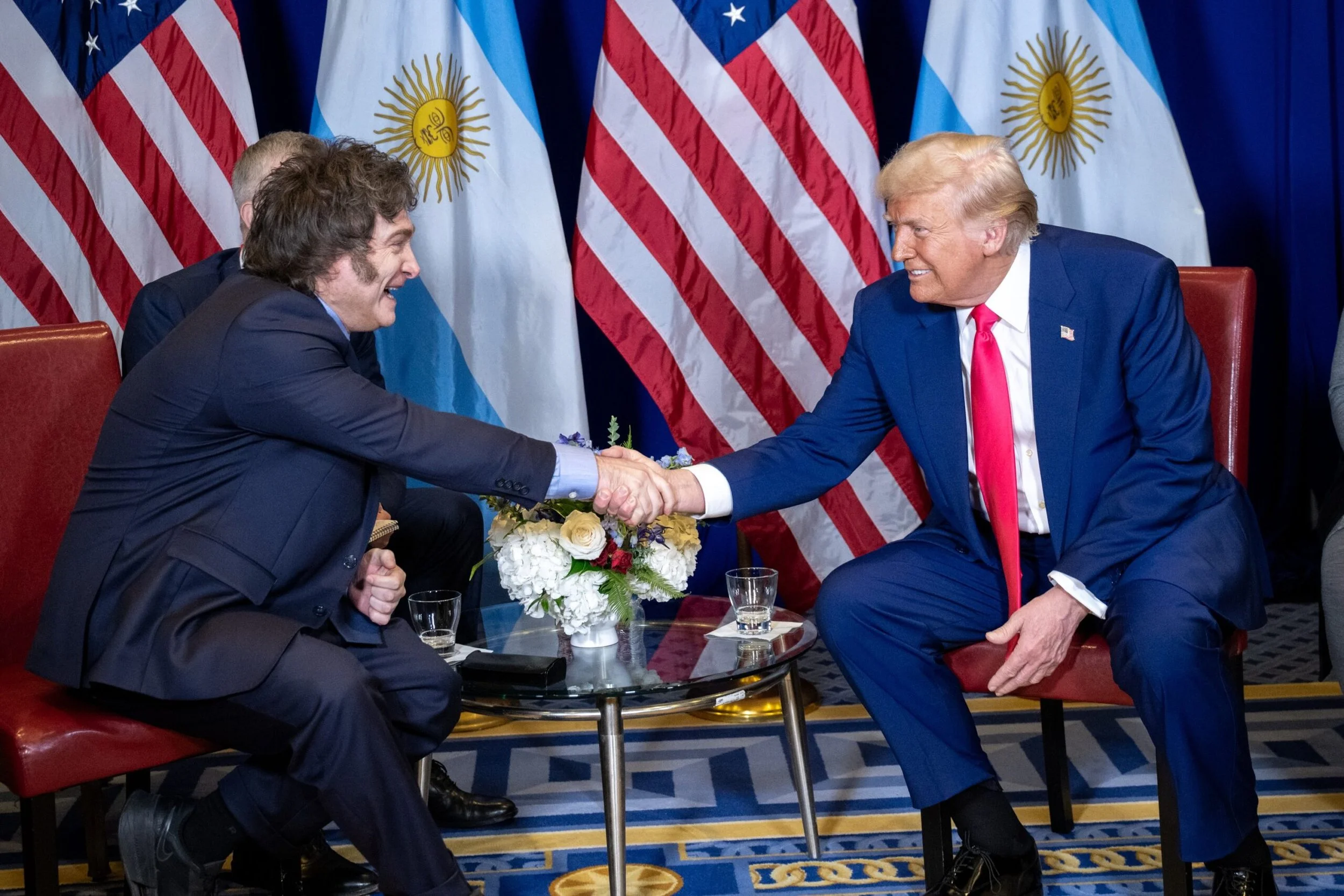
U.S. President Trump met with Argentine President Milei at CPAC in Washington D.C. to discuss Milei’s economic reforms and possibilities for cooperation.
Source: U.S. Embassy in Argentina
As populist leaders reshape the political landscapes of Argentina and the United States, the emerging alliance between Presidents Milei and Trump triggered controversy over a U.S. payout aimed at stabilizing the Argentine peso. In late 2025, surging inflation and the peso’s volatility created an opening for U.S. intervention. Because Argentina’s economy is heavily dollarized, instability in the peso threatens the value and credibility of dollar-linked assets, making its stability an American interest. In October 2025, the U.S. Treasury provided a $20 billion bailout intended to stabilize the Argentine peso and support the Milei administration’s economic agenda. While this effort aligned with the Trump administration’s geopolitical goals, its failure to stabilize the peso reveals the fragility of U.S. financial influence and suggests that the bailout was motivated more by political support for Milei than by economic stabilization.
Upon the election of President Javier Milei in 2023, Argentina undertook dramatic economic reforms. His monetary strategies, marked by aggressive cuts in government spending, “have been more ambitious than any in recent years.” While these policies helped curb inflation, the peso remained highly vulnerable because of its dollar dependence. Unlike other Latin American leaders, Milei openly supported financial ties to the U.S. dollar, promoting dollarization as a crisis-mitigation tool. By pursuing exchange-rate stability through U.S. dollar swaps in a globally mobile capital environment, Argentina effectively accepted the constraints of the Mundell-Fleming Trilemma framework, surrendering monetary authority to prevent the peso from collapsing. The Trilemma holds that no country can simultaneously maintain monetary autonomy, free capital mobility, and a fixed exchange rate; in open markets, a government must choose between controlling its money supply and stabilizing its currency. In Argentina’s case, Milei’s dollar swaps signaled a clear prioritization of exchange-rate stability over monetary independence. The peso was too weak to sustain a fixed rate on its own, particularly given Argentina’s low available currency reserves. Therefore, to uphold the stability Milei sought, Argentina required U.S. dollars as a credible reserve asset to bolster confidence in its currency and financial system. Milei has also pledged to pursue full dollarization and dismantle Argentina’s central bank, moves that would entrench the dollar’s role in Argentina. By granting the bailout, the United States nudged Argentina along this path, strengthening the dollar’s position in the region.
On the American side, the bailout served to advance the Trump administration’s financial and geopolitical interests. As Gillian Tett notes, “America’s hegemonic power today does not lie in manufacturing supply chains, since China dominates key chokepoints.” Instead, U.S. economic strength depends on its financial influence and the global dominance of the dollar. Deploying the dollar as a strategic instrument to preserve that dominance allowed the United States to maintain an edge over economic competitors. Argentina’s inflation decline, from 211 percent to 34 percent under Milei, demonstrated meaningful stabilization, indicating that U.S. support would not prop up a failing program but instead accelerate an already improving trajectory. The bailout, therefore, seemingly provided the United States with a unique opportunity to demonstrate the continued strength and reliability of the dollar, reassuring Argentina and investors worldwide.
Geopolitically, the bailout functioned as an instrument to advance key U.S. interests by constraining China’s influence in Latin America and strengthening the emerging U.S.-Argentina partnership. Under Trump’s economic policies, rising tariffs strained relationships with traditional economic allies, limiting the United States’ capacity to counter China’s expanding global influence. Partnering with President Milei, whose market-friendly agenda aligned with U.S. priorities, provided Washington with a valuable new ally at a time when economic alliances were contracting. This alignment helped restrict Chinese financial penetration in the region while reinforcing American geopolitical leadership.
The bailout’s implementation and outcomes, however, suggest that propping up the Argentine peso served Trump’s geopolitical interests more than U.S. financial stability. Although contentious in both Argentina and the United States, the currency swaps were formally announced on October 9, 2025. Specifically, “the Treasury Department agreed to purchase up to $20 billion dollars worth of pesos from Argentina’s central bank in exchange for U.S. dollars, using resources in the Department’s Exchange Stabilization Fund.” This support, however, was not unconditional. Trump publicly stated that, “If [Milei] wins, we’re staying with him…And if he doesn’t win, we’re gone.” This explicit contingency tied U.S. support to Milei’s political fate, signaling that the bailout was aimed less at propping up the peso and more at propping up Milei himself. By linking financial backing to his electoral success, the bailout forced the hand of the Argentine electorate, intertwining Milei’s victory with continued U.S. support.
Six months after the currency swap was established, economic indicators show no sustained stability in the peso. According to Trading Economics, the peso-dollar exchange rate remains highly volatile. In the five days following the dollar swap announcement, the peso initially strengthened, rising more than 5 percent against the dollar. Yet within another week, the rate reversed sharply, and the peso’s value declined. Since then, the currency has continued to fluctuate, failing to regain the short-lived gains observed immediately after the announcement. Argentina’s inflation trajectory mirrors this pattern. From October to November, inflation remained relatively steady at roughly 31.4 percent, reflecting the same short-term optimism seen in the exchange rate. However, by February 2026, inflation rates had risen by a net 1.9 percent, underscoring ongoing economic instability. The persistence of peso volatility, coupled with rising inflation, demonstrates that the Argentine bailout has thus far failed to stabilize the currency.
The Trump administration's $20 billion bailout to Argentina initially appeared to advance U.S. geopolitical and financial interests by maintaining Milei’s power, fostering economic alignment, and demonstrating the influence of a dollar-dominated economy. Its failure, however, revealed that the dollar could not stabilize the Argentine peso, which remains volatile amid rising inflation. While the United States may have hoped that partnering with Milei would bolster U.S. financial power and counter Chinese influence in Latin America, the outcome merely highlights the dollar’s fragility. Against a backdrop of strained relationships with major trading partners and escalating conflicts in Latin America and the Middle East, the bailout did little more than expose the United States’ declining financial leverage and the vulnerabilities inherent in its global monetary position.
