

Over A Year Later: Ecuador’s Narco-trafficking Crisis Effect on Democracy
Written by Fatima Pareja; Edited by Alex Tapia
January 31, 2025
Introduction
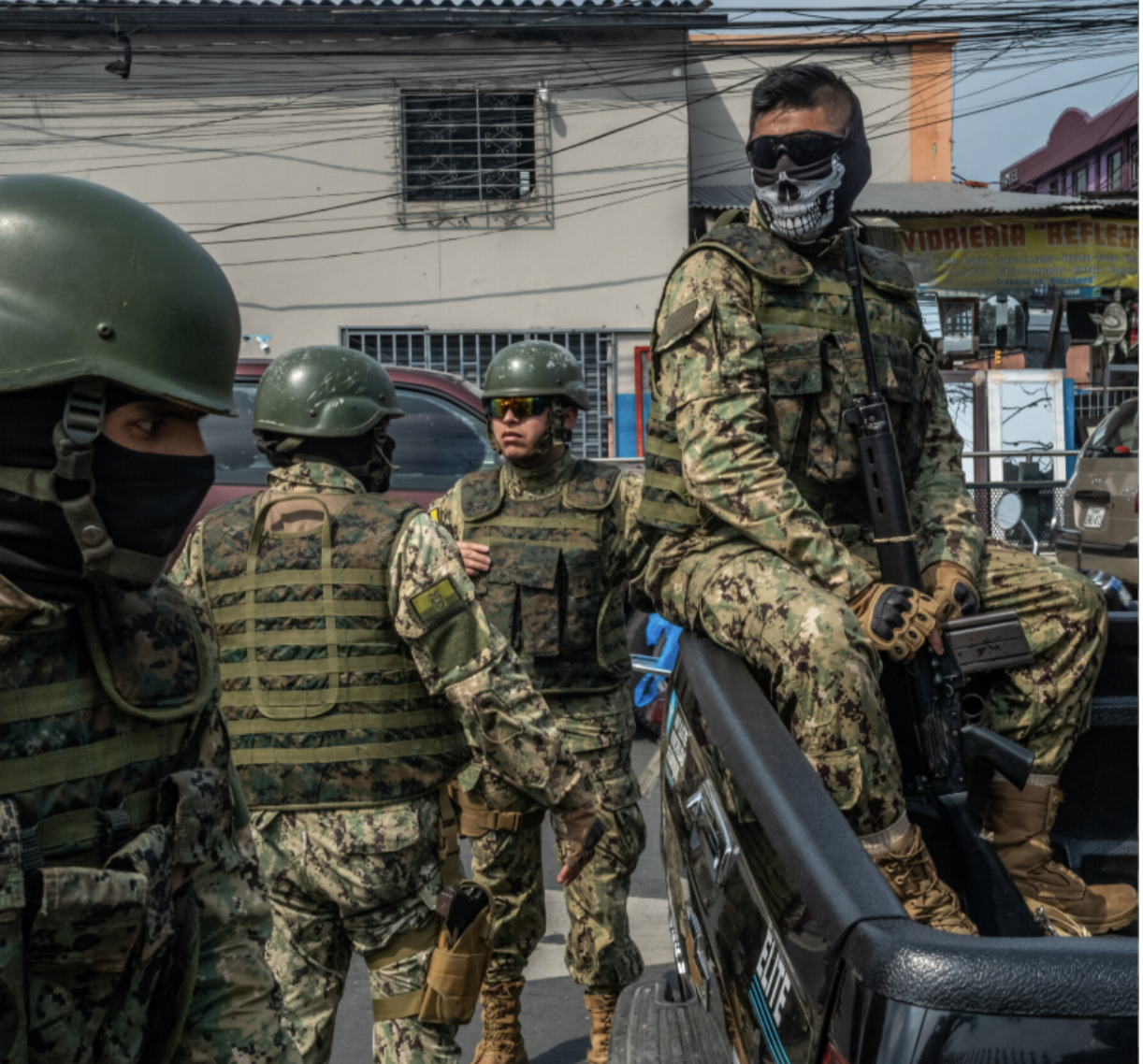
A gang in the Ecuadorian city of Guayaquil
Source: Federico Rios
In the abrupt 2023 election following former President Guillermo Lasso’s impeachment, Ecuador was confronted with the longstanding issue of drug-related criminal violence affecting its democratic processes. Prior to the August election, popular presidential candidate Fernando Villavicencio was assassinated by members of the notorious Los Lobos criminal organization after campaigning on a platform of anti-corruption and anti-narco-trafficking reform. In October 2023, Ecuador elected Daniel Noboa as its 48th president, and he ran on a similar platform. A few days after entering office, he announced the immediate implementation of his strict crackdown policy on organized crime, narco-trafficking, and corruption. However, following this announcement, there was a rise in robberies, kidnappings, killings, and other crimes in Ecuador. This became particularly pertinent when prominent Los Choneros drug lord Jose Adolfo Macias Villamar, or “Fito,” escaped from a prison in Guayaquil in January, sending the country into panic. In response to the unrest, Noboa declared a “state of emergency” and deployed armed forces while mandating a quarantine for civilians to mitigate the number of casualties during this intense process of criminal extraction. However, organized crime groups continued to wage a campaign of violence against the government and civilians. The conversation surrounding Noboa’s policy methods and the broader context of the situation raises a larger question about the impact narco-trafficking has on Ecuador’s ability to become a model democratic state in Latin America.
Daniel Noboa’s Plan Fenix
When President Daniel Noboa was elected, his policy, which came to be known as Plan Fenix, was centered on restoring security and fighting corruption across Ecuador. Consequently, organized criminal organizations did not respond kindly. Instead, they lashed out by intimidating and harming government officials, the press, and civilians. On January 8, 2024, President Noboa announced the implementation of Decree 111, which named and targeted twenty-two active organized crime groups through a “state of emergency.” This allowed Ecuadorian armed forces to target those involved in or colluding with drug-related criminal groups. Notably, Decree 111 did not exempt government officials from searches, as it was intended to eliminate corrupt behavior from the judicial branch.
Noboa’s policy has also gained attention based on its resemblance to El Salvador’s “Territorial Control Plan,” championed by President Nayib Bukele. Bukele’s success has motivated support for Noboa’s Plan Fenix because of surface-level similarities. However, notable differences in where the plan is implemented affect its success and distinguish it.
To start, Ecuador is much larger than El Salvador, which was able to execute its plan effectively within its means over a smaller territory. Unfortunately, Ecuador does not have the resources or time to quickly consolidate its forces across the country and its complex terrain; narco-trafficking groups can regroup even when Ecuadorian operations successfully break them apart. Moreover, the groups that Noboa and Bukele target have different organizational structures. Ecuador’s narco-trafficking networks are intertwined with other criminal groups, both regionally and internationally. The fracturing of these groups also adds a layer of difficulty to definitively stopping the drug trafficking business—splintered “organized crime groups” will simply find alternative routes.
Violations
Noboa’s plan has garnered the attention of international human rights organizations, which are concerned with the treatment and conditions of suspects and prisoners, as well as the lack of transparency in his policies. Between January and June of 2024, security forces conducted 120,000 operations resulting in more than 34,945 arrests, and according to Amnesty International, Ecuador’s Public Prosecutor’s Office listed reports of twelve cases of potential extrajudicial executions, four cases of potential enforced disappearances, and ninety-five potential cases of torture. Moreover, it was reported that “people deprived of liberty” had limited access to food, water, and medicine, all of which the state is required to provide.
Furthermore, the grouping of high- and low-level criminals together within Ecuador’s prison system makes lower-level criminals more susceptible to recruitment by narco-trafficking groups. Thus, the mixing complicates and delays plans to create a drug-trafficking-free state, as these lower-level criminals inevitably bolster the lifeblood of criminal organizations once they complete their sentences. However, if they are held for an extended period, the Noboa administration runs the risk of being portrayed negatively for violations of the rule of law—especially if Plan Fenix fails.
Recovering from Correa
Ecuador has had a complex history of narco-trafficking and corruption in government, which was perpetuated under former President Rafael Correa from 2007 to 2017. Correa’s time in office was marked by a rise in the middle class and by poorly structured institutions with declining transparency, as well as the removal of judges from office. The Ecuadorian judiciary and legislative system have generally struggled to provide free and fair governance. This was further reinforced by the FARC, the Revolutionary Armed Forces of Colombia, gaining access to the judicial branch in 2009. This can be attributed to its potential funding of Correa’s presidential campaign.
In the years following Correa’s final term, his legacy persisted through former members of his administration holding office. Lenin Moreno served as Correa’s vice president from 2007 to 2013 and was elected president in 2017. The pervasive influence of Correa, known as Correismo, finally loosened its hold with the election of Guillermo Lasso, who was ultimately impeached after dissolving the National Assembly. With this year’s election, there has been a further shift away from Correa, exemplified by the most popular candidates campaigning on anti-corruption and anti-narco-trafficking platforms. The Correa-endorsed candidate, Luisa Gonzalez, who previously served in various positions including Secretary of Public Administration, was unable to defeat Noboa despite her institutional backing. This shift alone does not prove a change in trajectory toward democracy, but the continuing response of the public may alter Ecuador’s future as citizens react to the popularity of Noboa’s plan and to how the country is changing post-Correa.
Changes in Democratic Freedoms
Freedom House’s Freedom in the World index measures democratic performance on a 100-point scale, combining scores for Political Rights (40 points) and Civil Liberties (60 points). Countries are then classified as Free, Partly Free, or Not Free based on their total score. In Ecuador’s 2017 report, reflecting conditions at the end of Rafael Correa’s presidency, the country scored 57/100, placing it in the Partly Free category. This total consisted of 24/40 in Political Rights and 33/60 in Civil Liberties. The report cited restrictions on opposition political organizations, pressure on independent media, and weaknesses in judicial independence. These figures suggest that democratic institutions were substantially constrained during the late Correa era.
By 2023, Ecuador’s score had improved significantly to 70/100, enough to move the country into the Free category. This indicates that, in the years after Correa left office, political competition became more open and civil liberties generally strengthened. However, this democratic recovery coincided with a worsening public security environment. Ecuador recorded more than 4,500 homicides in 2023, nearly double the total from 2022, as narco-trafficking networks and organized crime groups expanded their influence. The contrast between higher institutional freedom scores and deteriorating public safety suggests that Ecuador’s democratic gains were occurring alongside a rapidly deepening criminal governance crisis.
The 2024 Freedom House report shows the first clear reversal of that progress. While still classified as Free, Ecuador’s overall score fell to 67/100; its component scores declined to 29/40 in Political Rights and 38/60 in Civil Liberties. Although the drop was modest, it is significant because it followed the escalation of cartel violence during the 2023–2024 electoral period and the emergency security measures adopted by President Daniel Noboa. The data suggests that the narco-trafficking crisis, and the state’s aggressive response to it, began to erode some of the democratic improvements made in the previous decade.
Several subcategories help explain this decline. In Political Pluralism and Participation, Ecuador’s score fell from 3/4 in 2023 to 2/4 in 2024. This metric evaluates whether political parties can compete freely and whether citizens can participate without coercion. The lower score reflected assassinations of candidates and public officials, as well as reports of criminal organizations influencing campaigns, particularly in coastal provinces. In practical terms, organized crime reduced the fairness and security of democratic competition.
In Freedom of Expression and Belief, Ecuador’s score also declined from 3/4 to 2/4. This category measures media independence, the safety of journalists, and freedom from censorship. The reduction was linked to threats, attacks, and intimidation against journalists and media outlets reporting on crime and politics. As a result, some outlets self-censored or reduced coverage of sensitive issues. This suggests that cartel violence had a chilling effect on public debate and access to information.
The sharpest decline appeared in Rule of Law, where Ecuador’s score dropped from 2/4 in 2023 to 1/4 in 2024. This measure assesses due process, protection from illegitimate use of force, and equality before the law. The lower rating reflected both the growing power of criminal groups and allegations of excessive force by security personnel during Noboa’s anti-crime operations. Mass arrests after November 2023 reportedly added around 31,000 inmates to an already overcrowded prison system, intensifying concerns about detention conditions and state capacity. Taken together, these figures indicate that while Noboa’s policies were designed to restore order, they also generated new pressures on civil liberties and legal protections.
Much of the democratic decline shown in the Freedom House data demonstrates the negative relationship between democracy and narco-trafficking organizations. Noboa’s policies, though not mentioned directly in the assessment, clearly do not respect the democratic freedoms of prisoners, regardless of the severity of their crimes. Some policy experts, including Guillaume Long, a senior research fellow at the Center for Economic and Policy Research, suggest the violations of individual rights and the rule of law point towards authoritarianism through his “iron fist” approach. This narco-trafficking crisis contributes to the disruption of government and civilian processes, and the policies employed to combat it respond in kind. While some might argue these measures are necessary when dealing with transnational criminal organizations that terrorize a population, these processes nevertheless inhibit progress toward a model democratic state because of violations of the rule of law, restrictions on personal freedom, and the heavy-handed presence of the military.
Moving Forward
Ecuador’s institutional foundation is not equipped to properly support democratic processes that address major issues, but this does not mean it will never be able to do so. Drawing parallels to other previously crime-infested countries that were able to confront and overcome similar problems, Ecuador now has an opportunity to demonstrate its own resilience. Yet, the means to achieve its goals may be controversial, given the intensity and intricacy of the drug trafficking network in the country. Ultimately, solving its issues requires the state to determine what it is willing to sacrifice, and whether its choices will lay the groundwork for democratic progress in the future.
